Stocks Politicians Are Buying Right Now — Latest Filings

What Counts as a Congressional Stock Purchase?
Every few months, headlines resurface about stocks politicians are buying — and just as often, the follow-up question is whether any of it actually means anything for retail investors. The answer starts with understanding what a "congressional stock purchase" legally is: a disclosed transaction, reported under federal law, not a tip or a signal in itself.
Members of the House and Senate are permitted to buy and sell individual stocks. What they can’t do is trade on material, non-public information gained through their official role — a distinction covered in more depth in how congressional stock trading works. The mechanism that keeps this system observable — rather than invisible — is disclosure. That’s where this digest starts.
How Congressional Stock Trading Disclosures Work
The legal backbone here is the STOCK Act (Stop Trading on Congressional Knowledge Act), passed in 2012. It requires members of Congress to publicly file a Periodic Transaction Report for any trade over $1,000, covering the security, the transaction type, and a dollar range rather than an exact figure.
These congressional stock trading disclosures aren’t real-time. They’re historical records of trades that already happened — which matters for how you should read everything below.
The STOCK Act Disclosures Timeline
Filing deadlines follow a two-step clock:
30 days from when a member is notified of the transaction
45 days from the actual trade date, whichever comes first
In practice, that means the trade you’re reading about in a STOCK Act disclosures filing could be six weeks old — sometimes longer if a filing is amended or delayed. Any strategy built around this data has to account for that lag, not ignore it. It’s also worth noting this timeline is under active legislative scrutiny.
Most Bought Stocks by Congress This Quarter
Rather than spotlighting individual lawmakers, this section tracks aggregate patterns — which tickers and sectors show up most frequently across recent filings. That framing matters: a single large purchase by one member says very little on its own, but repeated appearances of the same ticker across multiple, unrelated filings is a more interesting data point.
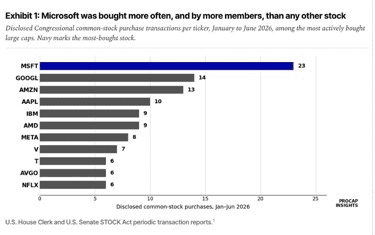
Historically, sector concentration has skewed heavily toward technology, with mega-cap names among the most frequently disclosed holdings across hundreds of members over the past decade. Healthcare, financials, energy, and defense round out the next tier.
How to Track Congressional Stock Trades Yourself
If you want to follow this data directly rather than through a digest like this one, the primary sources are:
Congress.gov — official bill and disclosure records
House Clerk’s Office and Senate Ethics filings — the source documents themselves
Third-party aggregators that compile filings into searchable databases
Each comes with tradeoffs. Primary sources are authoritative but unindexed and slow to search manually. Aggregators are faster to browse but vary in how quickly and accurately they process new filings.
Manual Tracking vs. a Congress Trading Tracker
Manually checking primary sources works if you’re researching a specific member or ticker. It doesn’t scale if you want ongoing visibility into disclosure patterns across all 535 members. That’s the gap a congress trading tracker is built to close — consolidating filings as they’re published rather than requiring you to check multiple sources by hand.
Turning Disclosures Into a Repeatable Strategy
Reading disclosure filings is one thing. Acting on them systematically is another — and that’s where most manual approaches break down. By the time a trade is disclosed, it’s already 30–45 days old. Checking filings sporadically means you’re seeing a partial, delayed picture at best.
Quantbase’s Congress Buys strategy is built around this exact mechanism: it tracks stock purchase disclosures from members of Congress as they’re filed, and rebalances the portfolio accordingly — automatically, without requiring you to monitor filings yourself. Rather than trying to time entries around any single disclosure, it applies a consistent, rules-based process to the same public data covered in this piece.
Disclosure: Congress Buys is an automated, rules-based strategy. It does not provide individualized investment advice and does not take your full personal financial situation into account beyond the information you provide when you invest. It follows a fixed methodology rather than adjusting in real time to your circumstances. Consider whether an automated strategy fits your needs before investing.
If you’ve been manually checking stocks politicians are buying every quarter, this is the systematic version of that habit.
Follow the Filings Automatically With Congress Buys
Reading through disclosure filings every quarter is a solid habit — but it’s also a manual one. By the time you spot a pattern, act on it, and rebalance your own portfolio, weeks may have already passed since the underlying trades occurred.
Congress Buys applies a systematic version of exactly what this article walks through:
Tracks disclosures as they’re filed — pulling from the same STOCK Act filing data covered above, rather than requiring you to check Congress.gov or the House Clerk’s site yourself
Rebalances automatically — the strategy updates its holdings as new disclosures come in, so you’re not manually re-checking filings every quarter
Applies a consistent, rules-based process — the strategy follows the same disclosure data regardless of which member filed it, avoiding the temptation to chase any single "hot" trade
Reduces the delay you add on top of the filing lag — while individual filings are still subject to the STOCK Act’s 30/45-day reporting window, the strategy incorporates new disclosures into rebalancing as soon as they’re available, rather than sitting on the data
Fits into a broader portfolio — like Quantbase’s other automated strategies, it runs with automated trade execution and tax management, so it’s one allocation among many rather than a standalone bet
If you’ve been bookmarking this page to check back on quarterly, Congress Buys is the version of that habit that runs itself.
[Explore the Congress Buys strategy →]
Quantbase, LLC is an investment adviser registered with the SEC. Registration does not imply any special degree of skill or training, or any approval by a regulatory authority of an adviser’s investment methods. This is for informational purposes only and is not investment advice or an offer to buy or sell any security. Investing involves risk, including possible loss of principal. Past performance does not guarantee future results.
Quiver Quantitative receives a percentage of advisory fees collected on assets invested in its strategy on the Quantbase platform. This is a conflict of interest because it gives Quiver Quantitative an incentive to recommend Quantbase whether or not it is right for you. Quiver Quantitative is a client of Quantbase.
Congress Buys carries a $30 per month subscription paid directly to Quiver Quantitative, in addition to Quantbase's platform and advisory fees. The strategy holds a concentrated set of positions and relies on public filings that are reported 30 to 45 days after the underlying trades. Concentration and reporting lag are material limitations of the approach. The conflict paragraph above is well drafted and should stay.
FAQ
What stocks are politicians buying right now?
It varies by filing period — the disclosures update as members file Periodic Transaction Reports, typically weeks after the actual trade date.
Why do congressional stock disclosures take so long to appear?
The STOCK Act allows up to 45 days from the trade date (or 30 days from notification) before a member must file.
Is it legal for members of Congress to trade stocks?
Yes. The STOCK Act restricts trading on material non-public information — it doesn’t prohibit lawmakers from owning or trading individual stocks. For a closer look at where that line sits, see is congressional stock trading actually insider trading?
Where can I see the most bought stocks by Congress?
Congress.gov and the House Clerk’s office publish original filings; aggregators compile them into searchable form.
Do congressional trades predict stock performance?
Disclosures show past transactions, not forward-looking recommendations — the SEC and most researchers caution against treating them as investment advice.
Quantbase, LLC is an investment adviser registered with the SEC. Registration does not imply any special degree of skill or training, or any approval by a regulatory authority of an adviser’s investment methods. This material is for informational and educational purposes only. It is not investment advice, a recommendation, or an offer to buy or sell any security, and it does not consider your objectives or circumstances. Investing involves risk, including possible loss of principal. Past performance does not guarantee future results, and no strategy is guaranteed to meet its objective. Advisory services are provided only under a written advisory agreement. Review Quantbase’s Form ADV Part 2A and Form CRS at https://getquantbase.com/disclosures before investing.

Other blogs

