Jim Simons Trading Strategy: Lessons for Quant Investors

Jim Simons Trading Strategy: Lessons for Quant Investors
What happens when a mathematician with no Wall Street training decides the market is a data problem? That question sits at the heart of the Jim Simons trading strategy. It’s also why his name still comes up whenever investors talk about quant.
One thing up front: Renaissance never published its models. This post covers what’s publicly documented about how the firm worked and the principles retail investors can take from it. It isn’t a blueprint.

Photo Credit: Bob Paz / The Wall Street Journal
Who Was Jim Simons? The Man Behind Renaissance Technologies
Simons was a mathematician long before he was an investor. He earned a math degree from MIT in 1958 and a PhD from UC Berkeley at 23, taught briefly at MIT and Harvard, and then worked as a codebreaker at the Institute for Defense Analyses. After being dismissed for publicly opposing the Vietnam War, he went on to chair the mathematics department at Stony Brook University.
In 1978 he left academia to start a trading firm called Monemetrics, which was later renamed Renaissance Technologies. He died in New York in May 2024, at 86.
How Did Jim Simons Make Money?
Simons made his money through the firm he founded. His fortune came from owning Renaissance and the trading profits its funds earned over several decades. Moving into investing in his 40s, he set aside standard industry practice in favor of quantitative analysis.
How the Jim Simons Trading Strategy Worked
The specifics stayed private, but the broad shape of the approach is well documented.
Quantitative Trading: Finding Patterns in Data
The core idea was to search market data for patterns that predicted price changes. That’s quantitative trading at its most basic:
Treat prices and other market information as data.
Look for patterns that repeat more often than chance would suggest.
Test whether those patterns hold up before acting on them.
The people mattered as much as the math. Simons largely avoided hiring Wall Street veterans. He recruited mathematicians and scientists instead, including astrophysicists and codebreakers, to find signals in huge volumes of data. Early hires included mathematicians Leonard Baum and James Ax.
Algorithmic Trading: Letting Models Make the Calls
In algorithmic trading, a computer program makes buy and sell decisions using predefined rules rather than case-by-case human judgment. The diagram below shows the basic flow from data to automated decision.
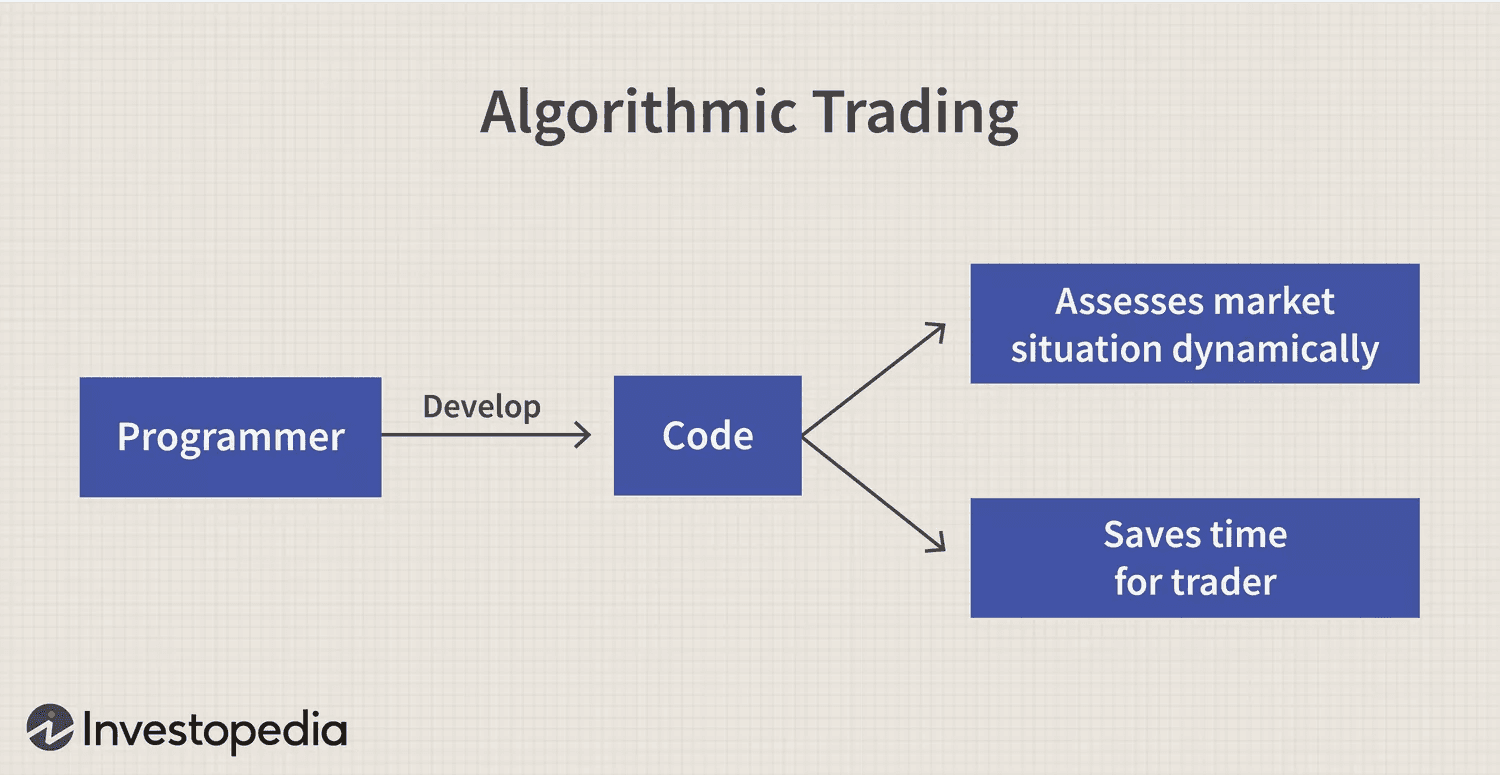
Image courtesy of Investopedia
Gregory Zuckerman’s reporting describes how Renaissance moved over time from blending human calls with model output toward relying on its models’ signals.
Be clear about what automation does and doesn’t do:
It makes a process consistent and repeatable.
It doesn’t make a model correct. A flawed model applies its flaw every time.
Many Small Bets, Not a Few Big Ones
A small statistical edge only means something when applied across a large number of independent trades. Any single trade can go either way; the model tries to capture a slight tilt repeated many times.
That edge is fragile, for three reasons:
Trading costs can eat it.
Competition can erase it.
The pattern behind it can simply stop working.
What We Know About the Medallion Fund, and What Stayed Secret
Renaissance launched Medallion, its flagship fund, in 1988. In 2005 the firm made it an employee-only fund, open to current and former staff. It remains closed to outsiders and deliberately secretive. Renaissance launched a separate institutional equities fund for outside investors in 2005, but the Medallion Fund was never opened back up.
Table 1 below sets out what the public record does and doesn’t show:
Publicly documented | Never disclosed |
|---|---|
The firm’s scientist-heavy hiring approach | The specific signals and data sources |
Its reliance on pattern-finding in data | The models themselves |
Medallion’s closure to outside investors | How positions were sized and executed |
Table 1: What is publicly documented about Renaissance’s approach vs. what has never been disclosed. Sources: Bloomberg obituary as republished by Fortune (May 10, 2024); Zuckerman (2019). As of September 21, 2026.
Because the models were never made public, any course or product presented as “the Simons system” isn’t drawing on Renaissance’s actual methods. Simons himself reportedly believed the firm’s algorithms would stop working if Medallion grew too large. Even the original had limits.
Lessons From the Jim Simons Trading Strategy for Retail Investors
Test Ideas Against Data Before Trusting Them
Treat any trading idea as a hypothesis until data supports it. Testing a rule on historical data is a reasonable starting point. Historical tests can also mislead, though, because a rule can end up fitted to past noise rather than to a real pattern.
Follow the Rules You Set, or Change Them Deliberately
If you use rules, decide in advance what would make you revise them. Overriding a rule on a hunch mixes two methods, making it hard to tell which one drives your results. Following rules doesn’t guarantee good outcomes, but it makes your process clear enough to evaluate.
Know What You Can’t Replicate
Renaissance’s key advantages aren’t available to individual investors:
Decades of data collection
A large team of scientists
Specialized trading infrastructure
What transfers is the mindset: skepticism, testing, and discipline. The results don’t.
Want to Go Deeper? Read The Man Who Solved the Market
For the full story, The Man Who Solved the Market by Wall Street Journal reporter Gregory Zuckerman (2019) traces Simons’ path from academia to Renaissance. Keep in mind that it reflects the author’s reporting: the firm itself never disclosed its models.
The Bottom Line
The Jim Simons trading strategy can’t be copied, and it was never designed to be. What investors can borrow is the approach behind it:
Treat ideas as hypotheses.
Let data, not hunches, decide what survives.
Stay consistent once you’ve set your rules.
Be honest about the limits of what you can build.
None of that guarantees results. It’s simply a useful way to think about quant investing.
Frequently Asked Questions
What was the Jim Simons trading strategy?
Renaissance used mathematical models to find patterns in market data and traded on them systematically. The specific models, signals, and data sources were never made public.
How did Jim Simons make money?
He built his fortune by founding and owning Renaissance Technologies, whose funds earned trading profits over several decades. He didn’t operate as a traditional stock picker.
Can you invest in the Medallion Fund?
No. Medallion has been limited to Renaissance’s current and former employees since 2005. The firm has run separate funds for outside institutional investors.
Can retail investors copy the Jim Simons trading strategy?
No. Renaissance never published its models, and its data, staff, and infrastructure aren’t available to individuals. What transfers are principles like testing ideas against data and following the rules you set.
What is the difference between quantitative trading and algorithmic trading?
Quant models use statistics to decide what to trade, while algorithms execute trades by predefined rules. The two often overlap, since a model’s signals can be carried out by an algorithm.
This content is educational and general. It is not investment, legal, or tax advice, is not a recommendation to buy or sell any security, and does not consider your individual circumstances. Any securities or strategies mentioned are illustrative only. Consult a qualified professional about your situation.

Other blogs