Is There a Retail Trader Edge Against Quant Funds?

Is There a Retail Trader Edge Against Quant Funds?
Retail traders and quant funds aren't playing the same game. Quant funds compete on data, speed, and execution, which are areas where individuals can't match institutional resources. If a retail trader edge exists, it sits in constraints rather than capabilities: the things a small, independent trader doesn't have to do.
Debates about institutional vs retail investors tend to treat the question like a scoreboard. A more useful question is structural: what can each side do, and what does that mean for your own rules-based trading?
Quant Funds vs Retail Traders: Two Different Games
A quant fund is a business built around a process. It raises capital from outside investors, runs models across large portfolios, and answers to clients, risk managers, and regulators. A retail trader manages their own money and answers to no one else.
When you compare quant funds vs retail traders, the useful lens isn't who's smarter. It's which problems each side is built to solve, and which ones it can avoid entirely. Before asking whether a retail trader edge exists, it helps to see what institutions are actually working with.
How Quant Funds Make Money
Understanding how quant funds make money starts with three advantages that are hard to replicate from a laptop.
Data at Scale
Quant funds can buy, clean, and combine datasets that go well beyond price charts. These can include alternative data such as satellite imagery, card transaction records, shipping data, and text from filings and news. Research teams test these inputs for signals, and engineering teams keep the data pipelines running. The real cost is the people and infrastructure that turn raw data into something tradable.
Speed and High-Frequency Trading
High-frequency trading is the extreme end of the speed race. HFT firms place servers physically close to exchange matching engines, a practice called colocation, so their orders arrive in microseconds. Their strategies depend on reacting to order-book changes faster than other participants.
A retail order routed through a broker app travels a much longer path. That isn't a flaw better software can fix; it's a structural gap. The diagram below shows the path a retail order takes before it's filled.
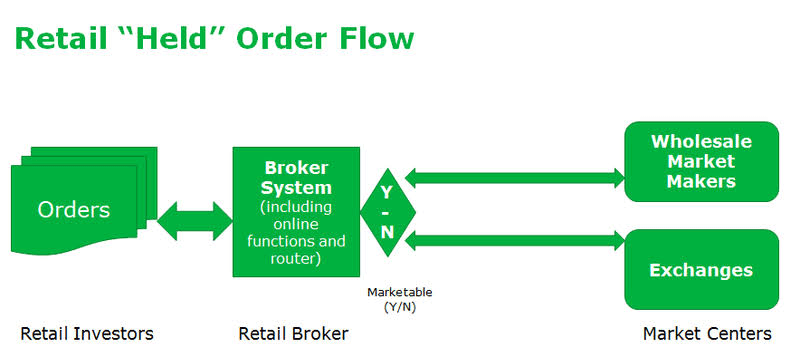
Source: TabbForum
Execution and Cost Control
Every trade carries costs beyond commissions. There's the bid-ask spread, and there's market impact, which is the price movement your own order causes. The illustration below shows where the spread sits in an order book.

Source: ResearchGate - Claudio Altafini
Large funds build execution algorithms that split big orders into smaller pieces to reduce that impact. Across large volumes, small execution improvements add up, so execution is treated as part of the strategy itself.
Why Popular Signals Fade: Alpha Decay Explained
Alpha decay describes what happens to a trading signal once it's discovered and widely traded. As more capital chases the same pattern, prices adjust faster, and the opportunity shrinks or disappears.
Three forces drive it:
Crowding: more traders acting on the same signal compete for the same trades.
Arbitrage: well-funded participants close pricing gaps quickly once they spot them.
Costs: as a signal weakens, trading costs can absorb what's left.
It's one reason a strategy that looked strong in historical testing can disappoint in live markets. That problem is covered in more detail in our guide to backtesting pitfalls.
Where a Retail Trader Edge Could Come From
If a retail trader edge exists, it doesn't come from better data or faster machines. It comes from constraints that institutions face and individuals don't. None of these guarantee better results. They are differences in structure, not advantages in outcome.
No Capacity Limits
A large fund can't easily trade small, thinly traded stocks, because building a meaningful position would move the price against it. A small account can enter and exit positions too small to matter to an institution. The trade-off is that thinly traded names tend to carry wider spreads and sharper price swings, so this freedom comes with its own costs.
No Redemption or Benchmark Pressure
Fund managers answer to investors who can withdraw money, potentially during a drawdown, which can force the fund to sell at unfavorable prices. Managers measured against a benchmark can also face pressure to stay close to it. A retail trader faces neither pressure.
The Freedom to Sit Out
A fund with a mandate is expected to stay invested and put capital to work. An individual can hold cash, wait, or skip a setup entirely. That flexibility only helps when it's used with discipline, though. Without rules, the freedom to sit out can just as easily become the freedom to act on impulse.
Retail Quant Trading: What's Realistically in Reach
Retail quant trading isn't about recreating a hedge fund at home. It's about borrowing the parts of the quant process that don't require institutional scale:
Write your rules down. Define entries, exits, and position sizes before you trade, so decisions don't depend on mood.
Validate before you commit capital. Check whether a rule holds up across different market conditions. Our checklist on how to validate a trading strategy walks through the steps.
Size positions deliberately. Decide in advance how much of your account any single idea can put at risk.
Count every cost. Include spreads and taxes, not just commissions, when judging whether a rule is worth running.
Assume your own signals can fade too, and review your rules on a regular schedule.
None of this removes market risk, and a disciplined process can still lose money. Its value lies in making decisions consistent and reviewable, not in guaranteeing results.
Key Takeaways
Quant funds hold structural advantages in data, speed, and execution.
HFT is a latency contest retail traders aren't built to enter.
Popular signals tend to fade as more capital trades them.
Any retail trader edge lies in constraints (capacity, investor pressure, and the freedom to sit out), not in capabilities.
Borrowing the quant process of rules, validation, sizing, and cost awareness is realistic. Outcomes are never guaranteed.
Frequently Asked Questions
What is a retail trader edge?
It's a structural advantage an individual trader may have over institutions. It comes from constraints like capacity limits and redemption pressure, not from the data and speed behind how quant funds make money, and it guarantees nothing.
Why can't retail traders compete with high-frequency trading?
It depends on servers placed next to exchange matching engines and orders that arrive in microseconds. A retail order travels a longer path through a broker, so competing on latency isn't a realistic goal.
What is alpha decay in trading?
It's what happens to a trading signal once it's widely known and traded. Crowding, arbitrage, and rising costs shrink the opportunity until it fades.
How do you get started with retail quant trading?
Start by writing your rules down, validating them before committing capital, sizing positions deliberately, and counting every cost. None of this removes market risk or guarantees results.
What's the difference between institutional vs retail investors?
Institutional investors manage pooled capital and answer to clients and regulators, while retail investors manage their own money. When comparing quant funds vs retail traders, that gap shows up in data, speed, and execution.
This content is educational and general. It is not investment, legal, or tax advice, is not a recommendation to buy or sell any security, and does not consider your individual circumstances. Any securities or strategies mentioned are illustrative only. Consult a qualified professional about your situation. |

Other blogs