The Full List of Publicly Traded AI Companies (Updated 2026)
What Counts as an AI Stock Company?
Not every company that mentions “AI” in an earnings call belongs on a serious list of AI stock companies. A useful definition draws the line at whether artificial intelligence is core to how the company makes money — not just a feature bolted onto an existing product.
Disclaimer: This content is educational and general. It is not investment, legal, or tax advice, is not a recommendation to buy or sell any security, and does not consider your individual circumstances. Any securities or strategies mentioned are illustrative only. Consult a qualified professional about your situation.
Quantbase, LLC is an investment adviser registered with the SEC. Registration does not imply any special degree of skill or training, or any approval by a regulatory authority of an adviser’s investment methods. This is for informational purposes only and is not investment advice or an offer to buy or sell any security. Investing involves risk, including possible loss of principal. Past performance does not guarantee future results.
This article organizes publicly traded companies by category using publicly available information; it does not describe any Quantbase-managed strategy or algorithm. Automated and quantitative approaches do not eliminate risk, do not guarantee any outcome, and can underperform. Models are built on historical data and assumptions that may not hold in future markets.
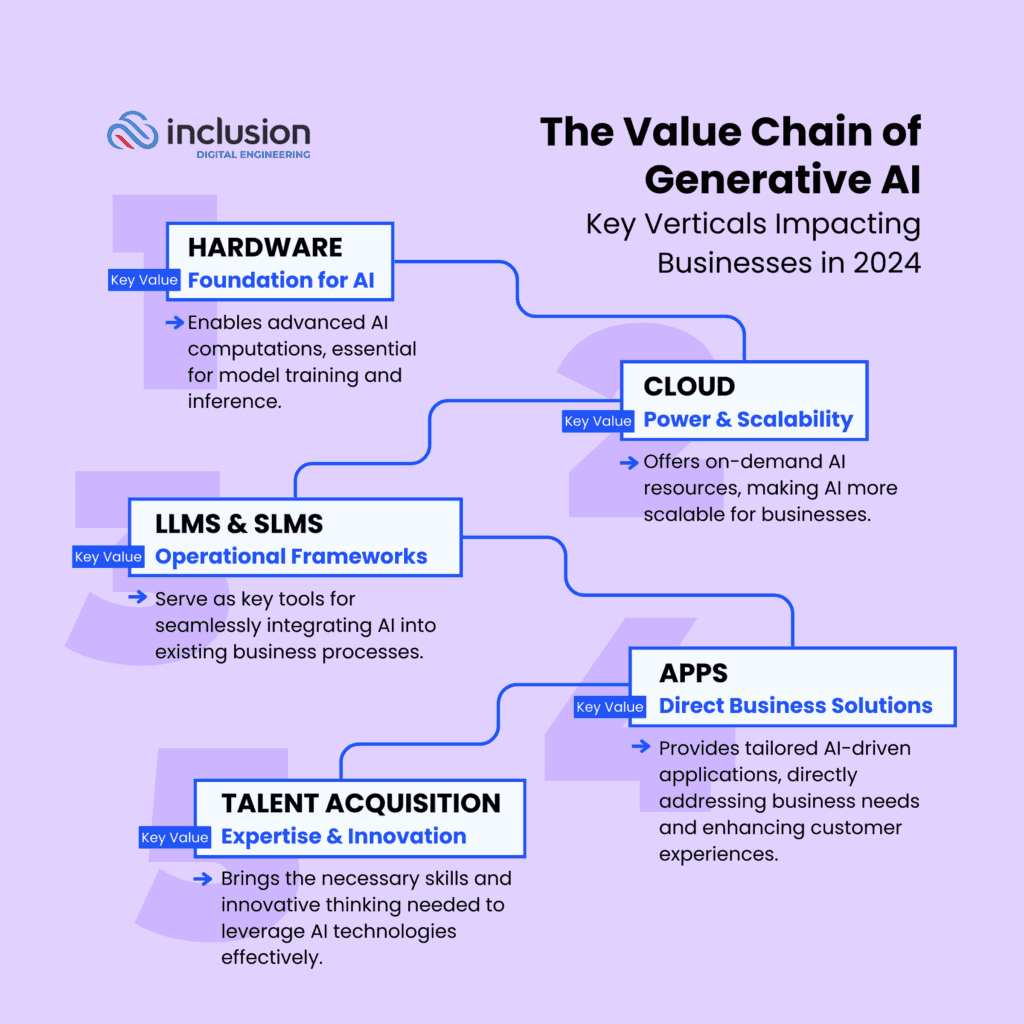
Broadly, publicly traded AI companies fall into three layers of the AI value chain: the hardware that trains and runs models, the cloud infrastructure that hosts them, and the software that puts them in front of users. Understanding which layer a company sits in matters more than any single price target, because each layer has different growth drivers, margins, and risk profiles.
The Full List of AI Stock Companies by Category
Here’s a working list of AI stocks, organized by where each business sits in the AI supply chain.
AI Chips and Semiconductors
These companies design or manufacture the processors that train and run AI models:
NVIDIA (NVDA) — dominant in GPUs used for AI model training and inference, with market share estimates for AI accelerators generally placed around 75 percent as of September 2026
Advanced Micro Devices (AMD) — competing GPU and data-center chip lineup
Broadcom (AVGO) — custom AI accelerators and networking chips
Taiwan Semiconductor Manufacturing (TSM) — the foundry that fabricates chips for most major AI hardware designers
ASML — makes the lithography machines chipmakers depend on
Cloud Platforms and AI Infrastructure
These businesses host the compute and data infrastructure that AI models run on:
Microsoft (MSFT) — Azure cloud, plus deep OpenAI integration across its product suite
Amazon (AMZN) — AWS, the largest cloud infrastructure provider
Alphabet (GOOG) — Google Cloud and its own Gemini model family
CoreWeave (CRWV) — specialized GPU cloud infrastructure built specifically for AI workloads
Oracle (ORCL) — expanding cloud infrastructure business increasingly tied to AI compute demand
AI Software and Applications
These companies build the tools, platforms, and applications that sit on top of AI infrastructure:
Palantir (PLTR) — data analytics platforms used by government and enterprise clients
ServiceNow (NOW) — AI-powered workflow automation for enterprises
Adobe (ADBE) — generative AI tools built into its creative software
Meta Platforms (META) — AI-driven ad targeting and its own foundation models
SoundHound AI (SOUN) — voice and conversational AI for consumer and enterprise use
This isn’t an exhaustive list — some trackers now count 80+ companies with meaningful AI exposure — but it covers the names that show up most consistently across the AI stock market’s major categories.[TF2]
How to Evaluate AI Stock Companies
Once you have a list of AI companies to invest in, the harder part is judging which layer of the value chain fits your outlook. A few starting questions:
Is AI core to revenue, or a feature? A cloud provider selling AI compute has a different exposure than a legacy software company that added a chatbot.
How concentrated is the customer base? Chipmakers in particular can carry customer concentration risk if a handful of large buyers account for most orders.
What’s the capital intensity? Infrastructure and chip companies require enormous ongoing capital spending; software companies generally don’t.
Is the company’s AI narrative reflected in its filings? Marketing language and SEC disclosures should tell the same story — if they don’t, that’s worth investigating further.
None of this replaces your own research or a conversation with a financial professional. Artificial intelligence stocks in 2026 span an unusually wide range of business models under one umbrella label, and treating them as a single trade can obscure real differences in risk.
FAQ
What are the biggest AI stock companies right now?
The largest by market cap include Nvidia, Microsoft, Alphabet, and Amazon, spanning chips, cloud infrastructure, and software.
Are all tech stocks considered AI stocks?
No — a company needs meaningful AI-driven revenue or infrastructure, not just AI features added to existing products, to count as a true AI stock.
What’s the difference between AI chip stocks and AI software stocks?
Chip stocks build the hardware that trains and runs AI models; software stocks build the applications and tools that use that hardware.
How many publicly traded AI companies are there?
Estimates vary, but trackers following the space now count well over 80 companies with meaningful AI business exposure.
Is investing in individual AI stocks risky?
Yes. Holding a small number of individual stocks concentrates your outcome in those specific businesses, so a setback at one company can have an outsized effect on your portfolio. Broader exposure spreads that risk across more names, but it does not eliminate market risk, and diversification does not guarantee against loss.
Quantbase, LLC is an investment adviser registered with the SEC. Registration does not imply any special degree of skill or training, or any approval by a regulatory authority of an adviser’s investment methods. This material is for informational and educational purposes only. It is not investment advice, a recommendation, or an offer to buy or sell any security, and it does not consider your objectives or circumstances. Investing involves risk, including possible loss of principal. Past performance does not guarantee future results, and no strategy is guaranteed to meet its objective. Advisory services are provided only under a written advisory agreement. Review Quantbase’s Form ADV Part 2A and Form CRS at https://getquantbase.com/disclosures before investing.

Other blogs

